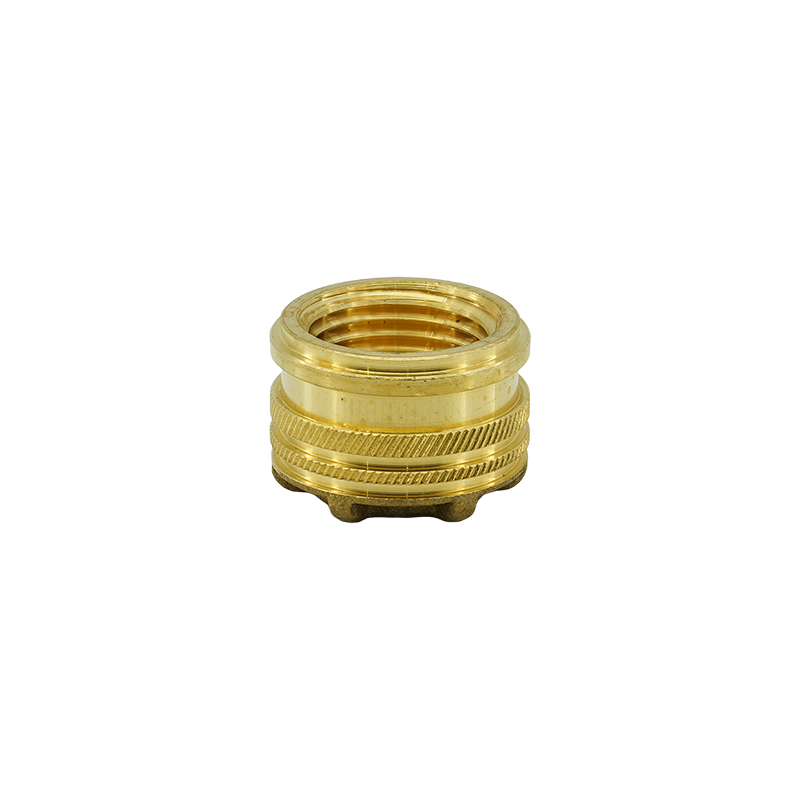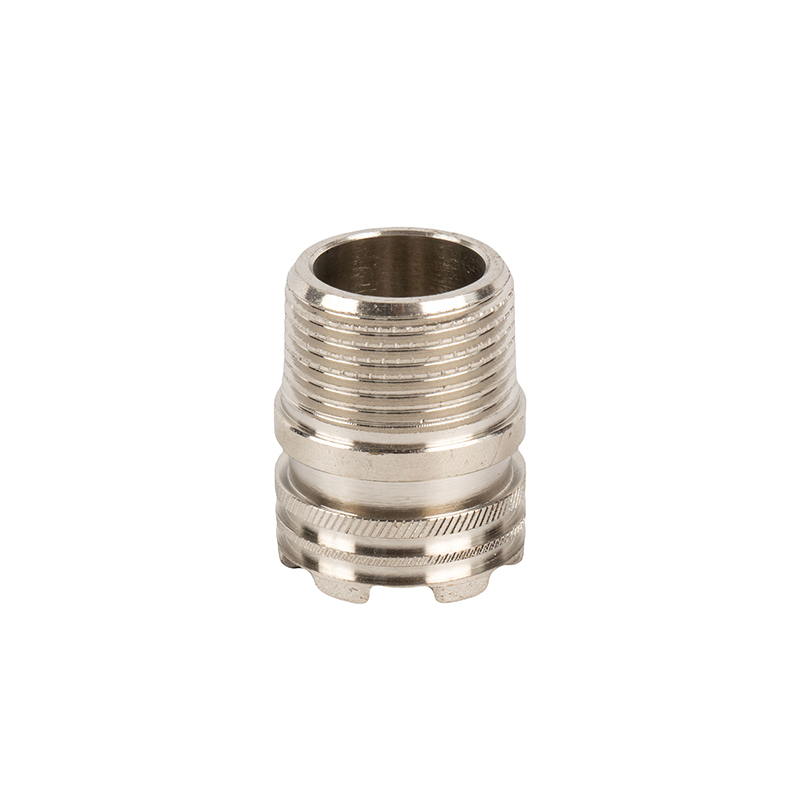

Put a brass elbow from 1965 next to one molded, forged, and machined this year and you will struggle to tell them apart by eye. The shape language has barely changed in eighty years, because the physics of joining a tube to a thread has not changed either.
What has changed is everything the eye cannot see. The alloy is different, because lead is no longer acceptable in drinking water. The manufacturing route has shifted, because pressure classes and wall thicknesses are tighter. The joint itself has moved from solder and thread to press, crimp, and push-fit, which moved the critical tolerances from the fitting to the tool. And the evidence trail has changed, because a distributor now needs to prove what the brass is, not just that it looks right.
This article treats those four shifts as engineering problems rather than marketing points, because that is how they fail in the field.
Brass is copper plus zinc, and almost every property that matters follows the ratio. More zinc buys strength and lower cost. More copper buys ductility, corrosion resistance, and a higher price, because copper is the expensive input by a wide margin.
The classic plumbing alloy was a free-cutting brass close to UNS C36000: roughly 61.5% copper, about 3% lead, balance zinc. It earned its place honestly. Lead does not dissolve in the brass lattice; it sits as discrete particles that act as chip breakers, lubricate the cutting edge, and allow high spindle speeds with a clean surface finish. That alloy is the 100% baseline against which every other copper alloy's machinability is rated. It also leaches lead into drinking water, which is why it is being displaced.
The replacements fall into four families, and choosing between them is a genuine trade-off rather than a marketing choice.

Silicon brass is the most interesting of these. It replaces lead's machining function with a hard silicide phase, and because it carries substantially more copper and far less zinc, it resists dezincification almost by construction. The cost shows up twice: in the metal itself, and in tool wear, because the same alloy that resists corrosion also grinds through carbide inserts faster. A foundry that quotes silicon brass at a leaded-brass price is either very efficient or not making what the drawing says.
Low-lead yellow brasses are the pragmatic middle. They keep enough zinc to forge and machine well, hold lead below the regulatory threshold, and cost less than silicon brass. They are common in insert fittings and valve bodies where the water chemistry is benign.
The regulatory thresholds are the reason this matters commercially. In the United States, NSF/ANSI 372 limits the weighted average lead content of wetted surfaces to 0.25%, and California's Proposition 65 adds warning obligations. Europe's recast Drinking Water Directive tightens the lead parameter and extends materials-in-contact requirements, with national schemes and the 4MS framework governing approvals. None of these require zero lead. They require that the average across wetted surfaces stays under a limit, which is why alloy selection, scrap segregation, and machining contamination control all become quality variables rather than purchasing details.
The manufacturing route leaves a signature
Four routes produce what the market calls a brass fitting, and each leaves a fingerprint in how the part eventually fails.
Hot forging. A billet is cut, induction-heated to roughly 700–750 °C, and formed in a closed die, then trimmed and machined. The grain flow follows the shape, the material is fully dense, and there is no gas porosity. This is why forged bodies hold pressure and why most quality valve bodies and many fittings are forged. Tooling costs are real, and wall thickness variation has to be controlled at the die design stage.
Die casting. Molten metal is injected into a steel die. Thin walls and complex external shapes come cheaply at volume, but gas porosity is inherent to the process, and porosity is a leak path waiting for pressure. Die-cast brass is acceptable in low-pressure and non-critical positions, and risky anywhere a pinhole would be a callback.
Sand casting. Coarse surface, thick sections, low volume, large sizes. Fine for drains and rough service, unusual in potable supply fittings.
Machining from rod or extrusion. The part is cut from bar and turned, with barbs and threads formed by cutting or rolling. Dimensional control is excellent, cost per piece is high, and this is the normal route for insert fittings, nipples, and adapters where geometry is the product.

The diagnostic value is direct. A leak through the wall points at the casting or forging process. A leak at the thread points at machining and tooling. A crack at the barb points at material condition and geometry. Knowing the route tells an engineer where to look before the lab report arrives.
The joint is the product
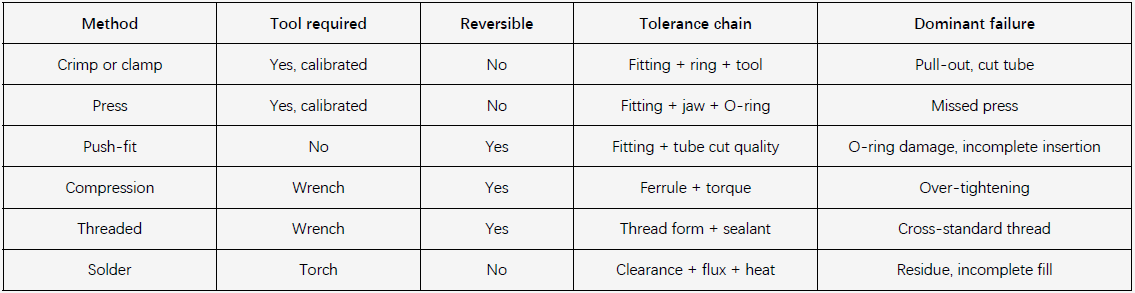
A fitting is half of a mechanical assembly, and the half that fails is usually the interface. Modern plumbing uses six joining methods, and each has a different tolerance chain.
1. Barbed insert with a crimp or clamp ring. The fitting's barbs sit inside the tube; the ring compresses the tube wall into the barb roots. Grip comes from the barbs resisting pull-out, and the seal comes from hoop stress. The critical dimensions are barb outside diameter, barb pitch, barb height, and the lead-in chamfer. A barb that is slightly under size produces a joint that passes a static pressure test and releases after thermal cycling; a chamfer that is too sharp shaves the tube on insertion and creates the leak path itself. ASTM F1807 governs this family for SDR9 PEX.
2. Press fittings. A stainless sleeve is compressed over the fitting body by a jaw tool, and an O-ring in the body makes the seal. The metal joint carries the load; the elastomer carries the seal. ASME B16.51 covers press-connect copper and copper alloy fittings, and EN 1254-7 covers press fittings for metallic tubes in Europe. The dominant failure mode is not the fitting at all: it is an unpressed or partially pressed joint that was never marked as pressed.
3. Push-to-connect. A grab ring bites the tube and an O-ring seals. Reversible, tool-free, and intolerant of a bad tube cut, debris, or a tube that is not pushed fully home.
4. Compression. A ferrule is deformed onto the tube by a nut. Simple and repairable, but torque-dependent, and over-tightening crushes the tube.
5. Threaded. NPT is tapered and seals by flank interference plus sealant; BSPP is parallel and seals on a washer or O-ring; BSPT is tapered. These are not interchangeable, and cross-standard assembly is a reliable way to produce a weeping joint that gets blamed on the fitting.
Soldered or brazed. Metallurgical joint, now made with lead-free solder. Flux residue left inside the bore is a corrosion initiator, which makes flushing a quality step rather than a courtesy.
Geometry details that decide reliability
1. Bore reduction. An insert fitting narrows the flow path, and the reduction is larger than most specifiers assume. A fitting whose bore is one or two sizes below the tube creates a localized pressure drop and a turbulence zone that accelerates erosion-corrosion downstream. When comparing suppliers, compare the actual bore, not just the nominal size.
2. Wall thickness at the thread root. The thinnest section of a brass fitting is almost always the thread root, and it is where installation torque concentrates. A part that passes a hydrostatic test in the factory can still split when a strong installer adds a turn and a half past snug. Adequate wall thickness and a proper chamfer at the thread start are cheap insurance.
3. Barb geometry. Height, pitch, and root radius work together. Too shallow and the joint pulls out under thermal movement; too tall or too sharp and the barb stress-cracks the tube or cuts it during insertion. Root radius matters as much as height, because a sharp root is a stress riser in the tube and a crack initiation site in the brass.
4. Dezincification. In water with chloride, dissolved oxygen, and stagnation, zinc can be selectively leached from high-zinc brass, leaving a porous copper sponge that looks pink and leaks. Temperature and low flow accelerate it. ISO 6509 immersion testing is the standard way to rank alloys, with a maximum penetration depth acceptance criterion that is commonly set at 100 µm, though the number should come from the specification, not from habit. The engineering answer is alloy selection first, geometry second, water treatment third.
5. Stress corrosion cracking. Brass under residual tensile stress, exposed to ammonia or amines, can crack along grain boundaries over months. The remedy is stress relief annealing after forming and machining, which is why "annealed" belongs on a drawing rather than in a brochure.
6. Galvanic coupling. Brass is cathodic to steel and drastically cathodic to aluminum. A brass fitting threaded directly to galvanized steel is a normal and acceptable joint until the zinc is consumed; brass to aluminum is a corrosion cell that will fail. Dielectric unions exist for a reason.
7. Freeze damage. Water expands by roughly 9% on freezing, and brass splits at the weakest section, usually a thread root or a hex transition. No fitting design prevents this, but uniform wall thickness determines whether the split is repairable or catastrophic.
The standards map
Specifications only work if they point at the right document. A practical map:
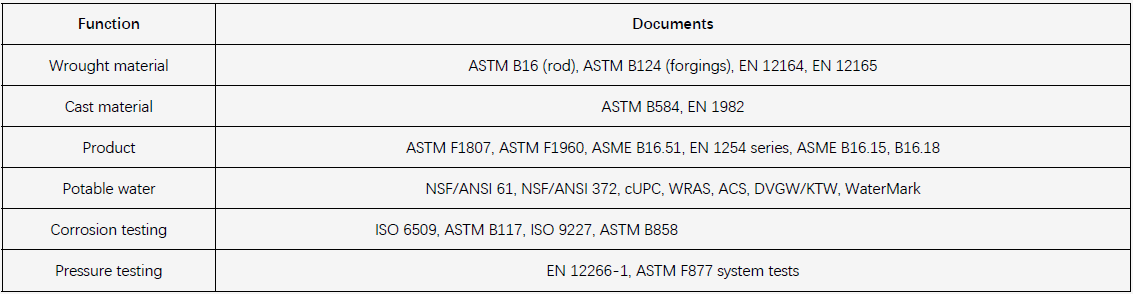
Two rules keep this map honest. First, material standards and product standards are different things; a mill certificate for B16 rod does not certify the finished fitting. Second, potable-water listings attach to a product family, an alloy, and a manufacturing location, so verify the listing covers the exact part and plant you are buying.
Specifying a modern fitting
A purchase order that says "brass fitting, 1/2 inch" leaves every decision that matters to the supplier. A specification that closes the gaps reads more like this:
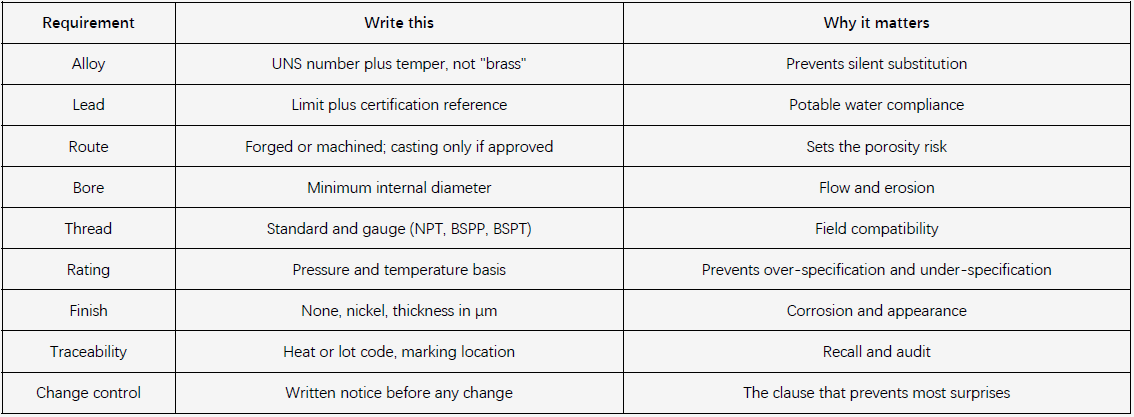
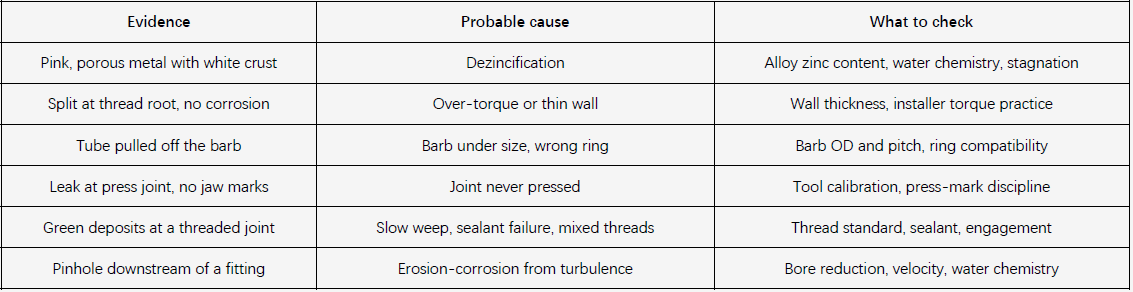
Field failures and what they actually mean
Where the category is heading
Three directions are clear enough to plan around.
Lead-free is spreading beyond the markets that mandate it. Gas, irrigation, and hydronic buyers increasingly specify low-lead alloys voluntarily, which pushes the whole supply base toward a narrower set of alloys and makes leaded material a specialty item rather than the default.
Press and push-fit continue to take share from solder in commercial work, driven by labor cost and by insurance concerns about hot work. That shifts the critical tolerance from the fitting's thread to the tool's jaw and the installer's mark, which means training and tool calibration become part of the product's quality system.
Traceability is becoming digital. Laser-marked lot codes and QR links to test reports are moving from aerospace habits into plumbing distribution, largely because a distributor facing a claim needs to identify a heat number in minutes, not weeks.
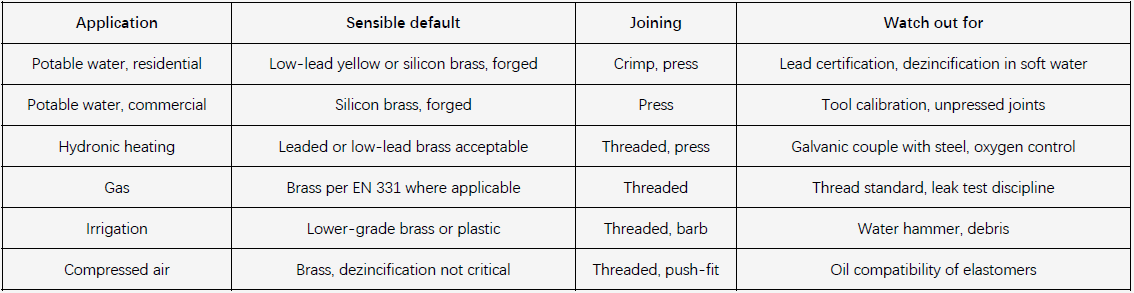
Choosing by application
FAQ
Q1: Is lead-free brass as strong as leaded brass?
A: Strength is governed mainly by copper-zinc ratio and temper, not by lead. Lead improves machinability, so removing it changes how the part is made more than how strong it is. Silicon brasses are typically stronger and harder than the free-cutting alloy they replace, which is also why they wear tooling faster.
Q2: Why does a brass fitting turn green?
A: Green carbonate deposits mean the surface is being attacked and copper salts are forming, usually from a slow weep, flux residue, or prolonged condensation. It is a symptom of water contact on an exposed surface, not a defect in the alloy itself, though it often accompanies a joint that is not fully sealed.
Q3: Can brass be connected directly to steel pipe?
A: Yes, with awareness. Brass is cathodic to steel, so the steel side corrodes preferentially, which is acceptable in many closed hydronic systems and unacceptable where the steel is thin or the water is aggressive. Dielectric unions break the electrical path when the couple matters.
Q4: How can I tell forged from cast without a lab?
A: Forged parts usually show a trimmed flash line, a denser surface, and no draft-angle taper on the body. Cast parts show ejector marks, a coarser surface, and parting lines with draft. Sectioning a sample settles it, and a supplier who cannot answer the question directly is telling you something.
Q5: Does nickel plating change potable-water compliance?
A: Yes. The coating becomes the wetted surface, so it has to be evaluated with the substrate under NSF/ANSI 61. A listing for bare brass does not automatically cover a plated version.
Q6: Why do press fittings fail if the fitting is fine?
A: Because the joint is made by a tool. An unpressed or partially pressed connection looks assembled, holds low pressure, and fails later. Press marks, jaw calibration, and installer training are part of the fitting's performance, not separate from it.
The short version
Modern brass plumbing fittings are a materials problem, a forming problem, and an interface problem at the same time. The alloy decides whether the part is legal and corrosion-resistant. The route decides whether it is dense. The geometry decides whether the joint grips without cutting. And the standard decides whether any of that can be verified after the fact.
Buyers who specify all four get a fitting that disappears into the wall and is never thought about again. Buyers who specify only the size and the thread get whatever the factory happened to be running that week, which is how a five-dollar part becomes a five-thousand-dollar claim.
-