
Ask a plumbing distributor in Texas, a wholesaler in Rotterdam, and a project buyer in Dubai where their brass ball valves come from, and the answer is usually the same: China, or a trading company that buys from China. This holds even for buyers who complain about tariffs, freight volatility, and the occasional lot that fails inspection. They complain, they switch suppliers, and they keep sourcing from the same country.
That persistence is not sentimentality or habit. It is the result of a supply chain that is unusually hard to replicate: a geographic cluster where brass rod, castings, machining, plating, seals, testing, and export logistics all sit within a few hours' drive of each other. Understanding why that cluster wins explains both the cost advantage buyers keep coming back for, and the failure modes they keep getting burned by.
The first mistake in evaluating Chinese brass suppliers is to picture a single factory. The real unit of production is a district.
Zhejiang's Taizhou area, and Yuhuan in particular, is the center of China's brass valve industry. Ningbo and Yuyao handle a large share of brass fittings, manifolds, and components. Guangdong's Kaiping is built around faucets and sanitary ware, and Fujian's Nan'an around the same category from a different supply base. These are not marketing claims; they are industrial ecosystems where a single street may hold dozens of machining shops serving the same product family.
The practical consequences for a buyer are concrete:
Sub-suppliers are local. If a die cracks, a plating line goes down, or a batch of O-rings is out of hardness, the problem is solved within the district rather than across an ocean. A factory in a mature but isolated industrial region would lose weeks to the same event.
Tooling moves fast. Mold and die shops that do nothing but brass valve tooling can quote in days and cut a new cavity in weeks. For a buyer launching a private-label line, this compresses the entire development cycle.
Labor is specialized. Operators who have machined brass ball valve bodies for fifteen years know what a bad seat cut sounds like. That tacit skill is not on any certificate, and it is difficult to build from scratch.
Scrap loops are short. Brass swarf and rejects go back to the rod maker or foundry nearby. The recovery value is captured locally, which quietly improves the economics of every part.
The cost advantage is not primarily labor
Buyers often explain Chinese pricing with "cheap labor." That explanation is out of date, and it leads to bad sourcing decisions. In a brass valve, labor is a minor cost line. Material dominates: copper alloy is typically the largest single input, often half the cost or more, followed by machining time, then plating, assembly, and testing.
China's advantage in this category comes from four places instead:
Material yield. Integrated producers buy rod in volume, run their own forging or casting, and recover scrap in a closed loop. A factory that wastes 3% less material than a competitor beats it on price without paying anyone less.
Throughput. High-volume dedicated cells, multi-spindle machines, and fixtures designed for one part family produce more good pieces per hour. The savings come from cycle time and first-pass yield, not from wage rates.
Tooling amortization. A mold or die spread across tens of thousands of units per year costs almost nothing per part. This is why standard catalog items are so cheap and fully custom low-volume items are not.
Plating and finishing in-house. Nickel and chrome lines, passivation, and laser marking under one roof remove a whole layer of margin and lead time.
The takeaway for buyers is that the discount is structural rather than temporary. It does not disappear when wages rise, because it was never mainly about wages. It does narrow when copper prices spike, because everyone's material cost rises together and the percentage gap shrinks in absolute dollars.
Catalog depth is an underrated advantage
A distributor does not want a supplier with forty SKUs. It wants one that can cover a catalog: ball valves from 1/4" to 4", mini ball valves, gas valves, gate and globe valves, check valves, boiler drains, sillcocks, compression fittings, barbed insert fittings, PEX manifolds, garden valves, filter valves, lockable handles, butterfly handles, extended stems, and the thread combinations that go with each (NPT, BSPP, BSPT, metric).
In the cluster, that breadth is normal. A single buyer can assemble a mixed container across three or four factories that all machine to the same dimensional conventions, which reduces the number of suppliers, the number of inspections, and the number of container consolidations they have to manage.
This is also why trading companies survive in this market. A good one is not a middleman adding margin for nothing; it is a catalog aggregator that holds relationships across twenty factories and takes responsibility for the mixed order. The risk is that a bad one adds margin while removing visibility, which is why buyers increasingly ask whether they are dealing with a factory or a trader, and whether the answer is stable.
Certification capability has become the real filter
Ten years ago, a Chinese brass valve factory could compete on price alone. Today, most serious buyers arrive with a certification list, and the list is what separates the top tier of suppliers from the rest.
What buyers commonly require:
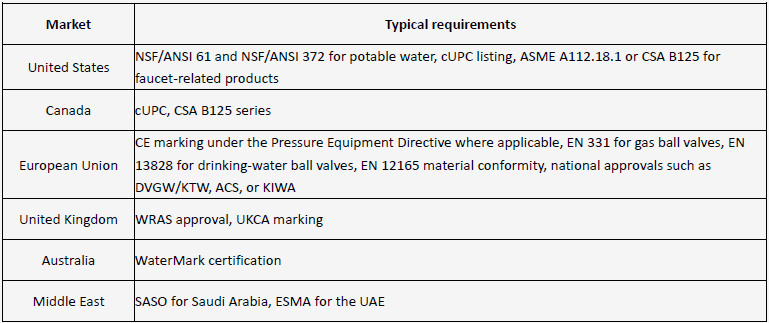
The important point is not that these certificates exist. It is that the capability to hold them is concentrated. A factory able to run NSF 61 leach testing programs, maintain DZR alloy control, and keep traceability intact across plating and assembly has made investments that a small workshop cannot match. That is why buyers who need certification tend to consolidate around a smaller group of suppliers, and why those suppliers can hold price better than the market average.
China's own regulatory pressure reinforced this. Export orders for lead-free brass pushed factories to adopt low-lead alloys and to control contamination in scrap and machining, because a single leaded-brass chip in the wrong bin can fail a lot. The factories that made that transition now supply both the US and European markets from the same process discipline.
Lead-free is now a capability, not a checkbox
The regulatory direction is one-way. In the United States, NSF/ANSI 372 limits the weighted average lead content of wetted surfaces to 0.25%, and California's Proposition 65 adds its own exposure warnings. In Europe, the recast Drinking Water Directive tightens the lead parameter and extends materials-in-contact requirements, with national schemes and the 4MS framework governing approvals. Certification bodies have also tightened lead leaching criteria under NSF/ANSI 61.
Complying means more than swapping an alloy grade on the drawing. Lead-free silicon brasses machine differently: they are more abrasive, they generate different chip forms, and they demand different tool geometries, feeds, and speeds. A factory that has already tuned its process for C69300 or C27450 will produce a stable part. A factory that has only run C36000 will produce scrap, or quietly revert to leaded material when a customer is not looking.
That is why the lead-free question is a useful test of a supplier. Ask which alloy they run, ask for the mill certificate, ask for the lead verification method, and ask what happens to swarf segregation. The answers separate real capability from a sales claim.
Export infrastructure that removes friction
Sourcing from China is also operationally easier than sourcing from many other low-cost regions, and this is a real, if unglamorous, advantage.
Ningbo-Zhoushan and Shanghai handle enormous container volumes with frequent sailings to every major port. Freight forwarders, consolidators, and customs brokers in the region operate in English and are accustomed to FOB, CIF, and DDP terms. Export documentation, certificates of origin, and inspection coordination are routine rather than exceptional. Payment mechanisms are well established, from telegraphic transfer to letters of credit and platform escrow.
For a mid-sized importer, this reduces the administrative cost per order. A container from a region with thinner logistics infrastructure can consume more management time than the product margin justifies.
Speed of iteration
Buyers consistently underestimate how much of their competitiveness depends on supplier responsiveness. In this category, a Chinese supplier will typically quote within a few days, produce samples in one to three weeks, cut a new mold in roughly three to five weeks, and run production in about a month after approval. These are typical ranges, not commitments, and they stretch during peak season or when a certification test is involved.
The value is not the absolute speed. It is the iteration loop. A buyer can test a design change, get a sample, find the problem, and revise within a single quarter. That loop is what allows a distributor to build a private-label range without holding a year of inventory risk.
Where the model breaks
An article that only lists advantages is a sales brochure, and sales brochures do not survive contact with a bad lot. The same cluster that produces excellent fittings also produces mediocre ones, often under the same product description and sometimes under the same certificate number.
Quality is not evenly distributed. The gap between the best and worst factory making "the same" brass ball valve is larger than most buyers expect. One runs SPC on seat geometry; another inspects by eye at the end of the line. Both will send you a price.
Material substitution is the classic failure. Recycled brass with off-specification copper content, or leaded alloy used where lead-free was specified, is difficult to see and easy to test for. If a price is far below the market, the difference is almost always in the alloy, the wall thickness, or the plating thickness.
Certificates do not always cover your part. A listing applies to a specific product family, alloy, and manufacturing location. Buyers regularly receive a certificate for a similar model made in a different plant, or for a leaded version of a product they are buying in lead-free form. Verify the listing in the certifier's public database, and check that the factory address matches.
Communication degrades under pressure. During peak season, the sales engineer who answered every email in an hour disappears. Technical questions get answered by whoever is available. This is a management-capacity problem, and it correlates with order size in ways buyers find frustrating.
Tariff and freight exposure is real. US Section 301 duties add 7.5% to 25% on top of the normal duty rate for many Chinese-origin goods, and the treatment depends on the specific classification. Rates and rules have changed repeatedly in recent years. Any sourcing decision has to be modeled on landed cost under current policy, not on the FOB quote alone.
Copying is a genuine risk. Tooling, packaging design, and private-label programs can reappear in a competitor's catalog. Non-disclosure agreements help; supplier selection and tooling ownership clauses help more.
How the best buyers actually behave
The buyers who get the most out of Chinese sourcing are not the ones with the lowest prices. They are the ones who treat supplier qualification as an engineering activity.
They audit before they order: walking the floor, checking calibration stickers, watching the leak test station, and asking to see the last three non-conformance reports. They send samples to an independent lab for alloy and lead verification rather than trusting the mill certificate alone. They write the alloy grade, lead limit, thread standard, pressure rating, and plating thickness into the purchase order, with a change-control clause that requires written notice before any substitution. They inspect pre-shipment at a defined AQL, and they keep a second approved supplier for every critical SKU even when they never use it.
They also stop treating "China" as one supplier. The country is a market of thousands of factories with a wide quality distribution. The buying decision is not which country, but which specific plant, verified by evidence.
FAQ
Q1: Are Chinese brass valves and fittings still the cheapest option?
A: For standard catalog items at volume, usually yes on landed cost, though the gap narrows with tariffs, freight, and anti-dumping exposure in some markets. For small custom runs with heavy certification requirements, a domestic or near-shore supplier can be competitive once engineering time and inventory risk are counted.
Q2: Can Chinese factories meet US and European standards?
A: Yes, a significant tier can. The capability is concentrated in factories that hold NSF/ANSI 61 and 372, cUPC, WRAS, ACS, DVGW, or EN 331 approvals, and that run in-house pressure and material testing. The qualification task is to confirm the certificate covers the exact product, alloy, and factory you are buying from.
Q3: How do I verify lead-free compliance?
A: Ask for the alloy grade and the mill certificate, confirm the NSF/ANSI 372 listing for that product and plant, and send a sample to an independent lab for ICP or OES analysis. Handheld XRF is useful for screening but is surface-sensitive and should not be the only evidence.
Q4: What are typical lead times?
A: Roughly one to three weeks for samples, three to five weeks for new tooling, and four to six weeks for production after approval, plus ocean transit. Peak season, Chinese New Year, and certification testing all extend these.
Q5: Should I buy from a factory or a trading company?
A: A factory gives you visibility and usually better price at volume. A good trading company gives you catalog breadth and handles mixed orders. The question to ask is who owns the quality decision, and whether you can audit the actual production site either way.
Q6: How many suppliers should I qualify?
A: At least two for any SKU that represents meaningful revenue, with one as the primary and one approved but idle. The second source is insurance against a quality failure, a tariff change, or a factory that stops answering emails.
The bottom line
Buyers keep sourcing brass valves and fittings from China because the cluster offers something that is genuinely difficult to assemble elsewhere: material, machining, finishing, seals, testing, certification, and export logistics in one place, at a cost structure driven by yield and throughput rather than wage arbitrage. That advantage is durable, and it is why the category keeps flowing through Ningbo and Shanghai even when the headlines are unfavorable.
But the advantage belongs to the cluster, not to any individual supplier. The factory you choose still has to be qualified, its certificates still have to be verified, and its alloy still has to be tested. Buyers who understand both halves of that sentence get the cost benefit without the remediation bill. Buyers who only understand the first half eventually become the case study someone else cites.
-


