

Brass insert fittings are small, cheap, and easy to overlook — until one fails. A cracked barb, a leaking thread, or a fitting that dezincifies after two winters in the ground can turn a low-cost component into an expensive warranty claim. For anyone sourcing brass insert fittings — whether for PEX plumbing, pneumatic systems, or threaded connections — the ability to judge quality before the order ships is what separates a reliable supply chain from a constant headache.
A brass insert fitting is a machined or forged brass component that joins tubing, pipe, or hose to another part. Depending on the application, the term covers:
● PEX / plumbing insert fittings — barbed brass fittings pushed into PEX tubing and secured with a crimp ring or clamp.
● Threaded inserts — brass fittings with NPT, BSP, or metric threads used to connect hoses, gauges, and manifolds.
● Pneumatic & fluid fittings — push-to-connect or compression bodies that rely on precision brass bodies and sealing surfaces.
Despite the differences in shape, the quality criteria are largely the same: the right alloy, accurate dimensions, sound threads, and a consistent surface.
1. Material Composition (The Most Important Factor)
Brass is a copper–zinc alloy, and which brass you get determines everything else.
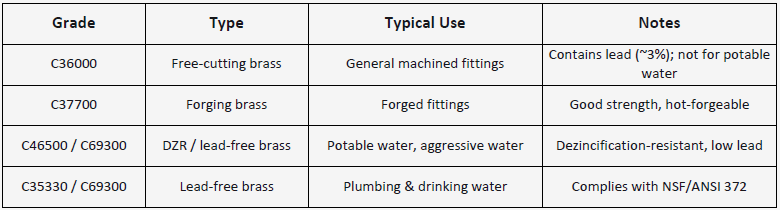
What to check:
● Lead content. For potable-water applications, the fitting must be lead-free (lead ≤ 0.25% by weighted average) and compliant with NSF/ANSI 61 and 372. Leaded C36000 is fine for industrial/non-potable use but is not compliant for drinking water.
● Copper-to-zinc ratio. Higher copper improves corrosion resistance but makes the alloy harder to machine. Genuine material certificates should state the exact copper and zinc percentages.
● Dezincification resistance. In aggressive or high-chloride water, ordinary brass can lose zinc and turn porous and pink. DZR brass (tested to ISO 6509) resists this.
Red flag: a supplier who cannot provide a material test certificate (MTC) or spectrometer report for the alloy they claim to ship.
2. Dimensional Accuracy and Tolerances
A brass insert fitting only seals and holds if its dimensions are within tolerance.
● Barb diameter and length — must match the tubing ID and the crimp ring spec, or the joint will leak or pull off.
● Thread pitch and diameter — measured with GO / NO-GO thread gauges, not by eye.
● Wall thickness — too thin means it deforms under clamp pressure; too thick wastes material and may not seat.
● Concentricity — off-center bores cause leaks and uneven sealing.
Ask for the dimensional drawing with tolerances and confirm that production is measured against it — not "measured by feel."
3. Thread Quality
Threads are where most leaks begin.
● Clean, complete threads with no burrs, tears, or cross-threading.
● Correct thread standard — NPT vs. BSP vs. metric — verified, not assumed. A BSP fitting threaded into an NPT port will leak.
● Taper and gauge engagement checked with the appropriate gauges.
4. Surface Finish and Plating
● No cracks, cold shuts, porosity, or inclusions visible at the surface.
● Consistent color — patchy or uneven color can indicate poor plating or contamination.
● Plating thickness (if nickel- or chrome-plated) verified by a coating thickness gauge. Thin plating corrodes early.
5. Mechanical Strength and Pressure Rating
● Pressure rating should be stated (PEX insert fittings are commonly rated to 200 psi at 73°F / 23°C, de-rated at higher temperatures).
● Tensile / pull-off strength for barbed fittings should be validated by testing, not just claimed.
● Hardness consistent with the specified alloy and temper.
6. Corrosion and Aging Performance
● Salt-spray testing (ASTM B117) for external corrosion resistance.
● Dezincification testing (ISO 6509) for potable-water suitability.
● Long-term aging / stress-corrosion evaluation for critical applications.
Quick field check: what a buyer can verify in 10 minutes
1. Weigh a sample against the nominal weight — significant under-weight usually means thin walls or the wrong alloy.
2. Run a magnet over it — good brass is not magnetic; strong attraction suggests iron contamination.
3. Check threads with a gauge and inspect under a loupe for cracks and burrs.
4. Snap or section one fitting to look for internal porosity — a sound casting/machining is dense and uniform.
5. Compare color across the batch — inconsistency signals process drift.
Contact us right now to coordinate a detailed technical consultation. Our rapid-response global specialists will deliver complete product specification sheets and volume contract pricing structures within twelve hours.
-


