
If you have ever put together a PEX plumbing system, you have almost certainly held a brass insert fitting in your hand. These small, unassuming components are the quiet workhorses behind reliable water distribution — connecting tubing to manifolds, fixtures, and appliances while holding back pressure day after day.
But "brass insert fitting" is a broad label. Underneath it sit dozens of shapes, sizes, thread types, and material grades — and choosing the wrong one can mean leaks, failed inspections, or a system that does not meet local code. This guide walks through everything a contractor, distributor, or engineer needs to know: what these fittings are, how they are made, which standards apply, and how to specify the right part the first time.
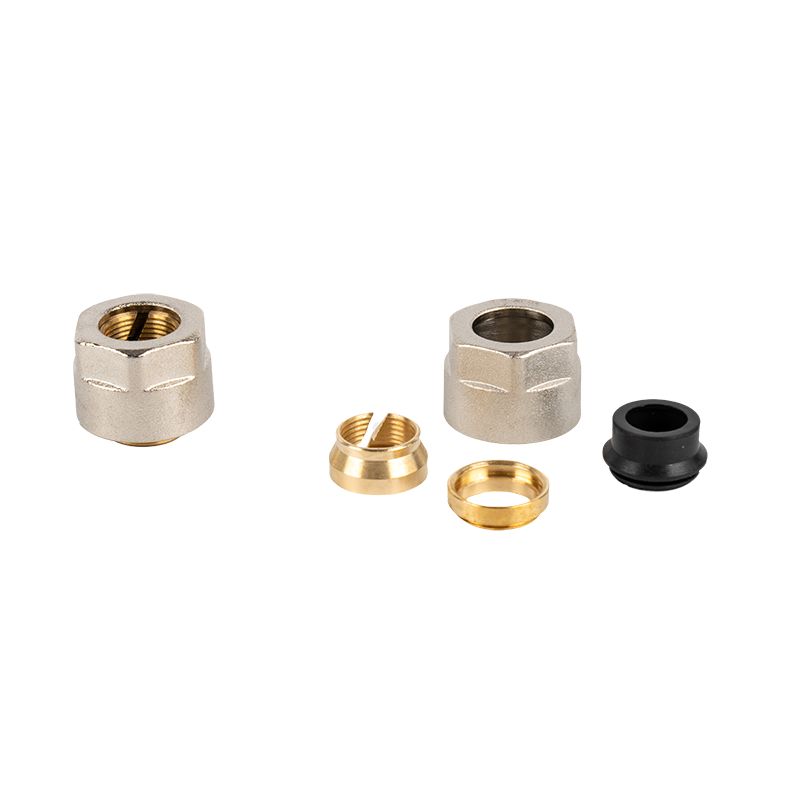
A brass insert fitting is a machined brass component that is inserted into the end of flexible tubing — most commonly PEX (cross-linked polyethylene) — to create a secure, leak-free connection. The fitting has a barbed end that slides inside the pipe, and the pipe is then locked in place with a metal crimp ring, clamp, or sleeve that compresses the tubing onto the barbs.
The barbs do two jobs: they grip the inside wall of the tube to resist pull-out, and they create multiple sealing points that stop water from travelling along the pipe. The brass body itself provides the mechanical strength and the transition to the next part of the system — a threaded port, a manifold, or another length of tubing.
In short: the insert fitting is the "male" barbed core; the crimp ring is the "outside" clamp. Together they form a mechanical joint rated to well over 100 PSI.
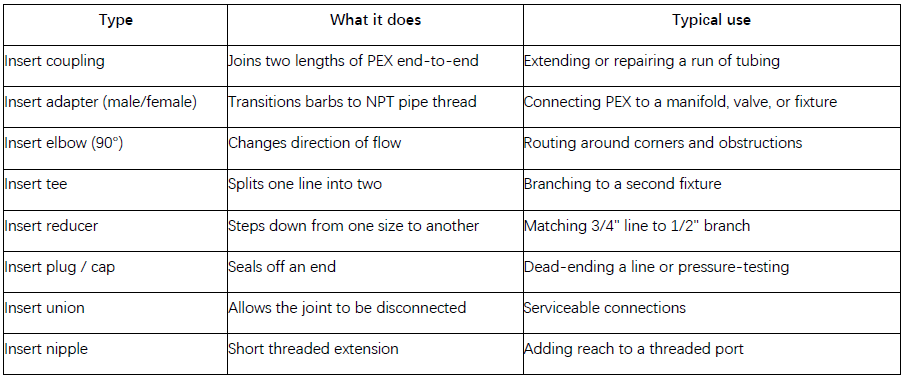
Although the core design is similar, insert fittings come in a wide range of shapes to solve different connection problems.
Sizes are quoted in the nominal tubing diameter — 3/8", 1/2", 3/4", and 1" cover the vast majority of residential and light commercial work. Larger sizes exist for industrial and agricultural systems.
Brass is chosen for insert fittings because it combines three useful properties: it machines cleanly into precise barbs and threads, it resists corrosion in potable water, and it holds up under decades of thermal cycling.
Historically, many fittings were made from free-cutting brass (such as UNS C36000), which contains lead to improve machinability. Because lead can leach into drinking water, regulations have moved decisively against it. Today, fittings intended for potable water must use lead-free brass alloys — for example silicon brass (C69300) or bismuth-modified alloys — that keep lead content below statutory limits while still machining reliably.
When you buy, insist on "lead-free" (LF) brass. Non-compliant fittings may be cheaper, but they fail inspection and, more importantly, they are not safe to install on drinking-water lines.
Because these fittings sit inside the water supply, they are heavily regulated. A credible brass insert fitting will reference several of the following:
• ASTM F1807 — the core product standard for metal insert fittings used with PEX tubing.
• NSF/ANSI 14 — covers plastic piping system components and related materials.
• NSF/ANSI 61 — drinking water system components; confirms the material will not leach harmful contaminants.
• ASTM F876 / F877 — the companion standards for the PEX tubing itself and its installation.
• cUPC / IAPMO listing — often required for plumbing code approval in North America.
A fitting that claims a pressure rating should state it clearly (commonly 100 PSI at 180 °F, or higher at lower temperatures). Ensure the rating matches your system's working pressure and temperature.
Brass insert fittings are found wherever PEX or flexible tubing needs a dependable mechanical joint:
• Residential plumbing — hot and cold water distribution, fixture supply lines.
• Radiant floor heating — connecting loops to manifolds.
• Water treatment and filtration — hooking up softeners and filter housings.
• Agricultural and irrigation — livestock watering and field supply lines.
• RV, marine, and mobile systems — where vibration resistance matters.
• Industrial OEM equipment — as a rugged transition inside machines and assemblies.
Work through these questions before ordering:
1. Tubing type and size. Confirm you are matching the correct nominal PEX size (e.g., 1/2" PEX). Insert fittings are not interchangeable with compression or push-to-connect styles.
2. Connection at the other end. Decide whether you need a plain coupling, a male/female NPT thread, or a reducer — and confirm the thread standard (NPT is the North American norm).
3. Angle and branch. Straight, 90° elbow, or tee, depending on how the run is routed.
4. Crimp system compatibility. Make sure the fitting works with your crimp tool and ring / clamp style (crimp ring, cinch clamp, or sleeve). Consistency across the job avoids tool changes and errors.
5. Material compliance. Lead-free brass plus the relevant NSF and ASTM listings for potable-water use.
6. Pressure / temperature rating. Match the fitting's rating to the system's design conditions.
7. Finish and inspection. Look for clean, burr-free barbs, well-formed threads, and uniform plating or natural brass finish.
Insert fittings are forgiving, but technique still matters:
• Cut square. Use a PEX cutter to get a clean, square end — a ragged cut is a common cause of leaks.
• Don't over- or under-insert. Push the fitting fully into the tube so all barbs are covered.
• Position the ring correctly. Keep the crimp ring square and within the recommended distance from the tube end.
• Use the right tool. Match the crimp or clamp tool to the ring size, and calibrate it as the manufacturer requires.
• Pressure-test before closing up walls. Test the system at or above working pressure and watch for weeping joints.
• Follow the manufacturer's instructions — they override general rules of thumb.
1. Are brass insert fittings the same as compression fittings? No. Insert fittings use a barbed brass core plus an external crimp ring or clamp; compression fittings use a nut, ferrule, and threaded body. They are not interchangeable.
2. Can I use brass insert fittings on hot water? Yes, provided the fitting's temperature rating covers your system. Many are rated to 180 °F or higher.
3.Do I need lead-free brass for drinking water? Yes. Any fitting on a potable-water line must be lead-free and should carry the appropriate NSF/ANSI 61 certification.
4. How long do brass insert fittings last? With correct installation and compliant materials, they are designed to last the life of the plumbing system. The crimp connection, not the brass, is usually the limiting factor.
5. Can I reuse a crimped fitting? No — cut out and replace the joint. Crimped rings and the deformed tube section should not be reused.
Brass insert fittings are small parts with an outsized role: they hold your PEX system together and keep water where it belongs. The differences between a good fitting and a problematic one come down to alloy choice, standards compliance, and matching the right shape and thread to the job.
Specify lead-free brass, confirm the relevant ASTM and NSF listings, match the size, angle, and thread to your layout, and install with the correct crimp system — and your connections will stay leak-free for decades.
Ready to specify your next project? Browse our full range of lead-free brass insert fittings — couplings, adapters, elbows, tees, and reducers — all compliant with ASTM F1807 and NSF/ANSI 61.